Ball Connect Puzzle: Link Dots
- 4.6
- Rating
- 10.00M
- Installs
- Free
- Price

 Analysis by App-foxy
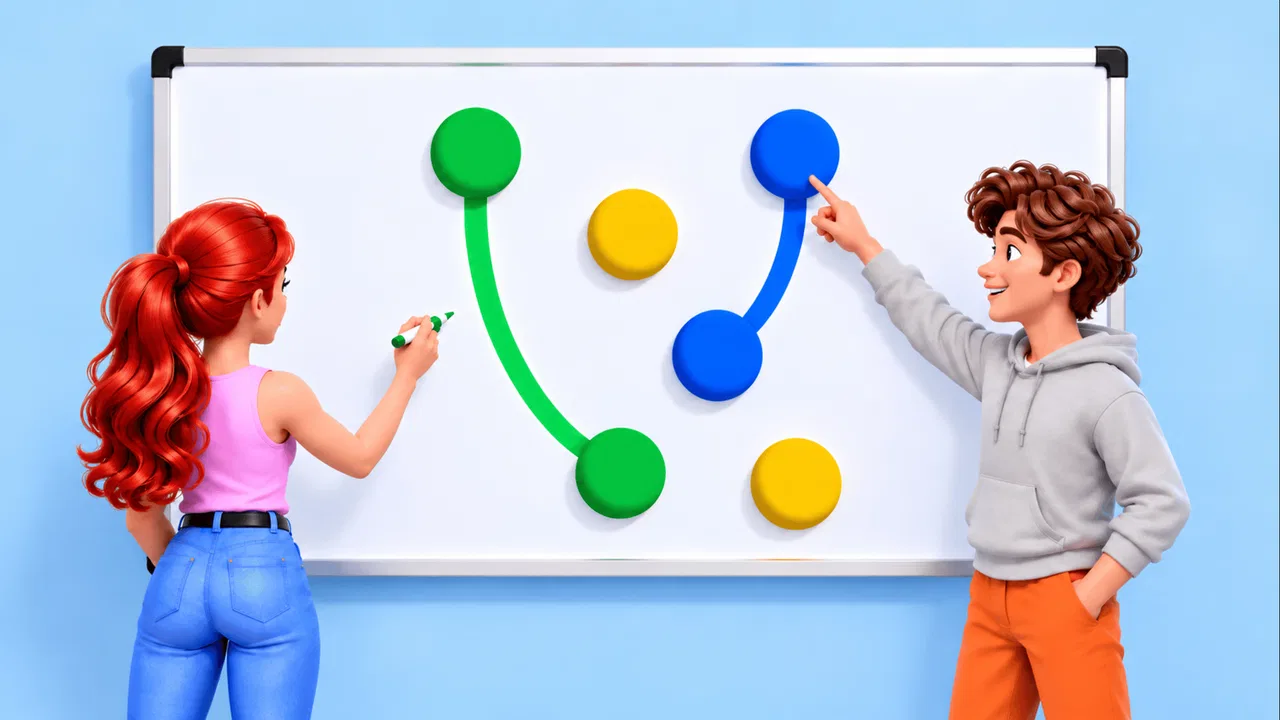
I spent time with Ball Connect Puzzle: Link Dots as a quiet, casual game rather than something designed to demand constant attention. Its central idea is easy to understand: connect balls of the same color while keeping the lines from crossing. That simplicity makes it approachable within seconds, but the boards still ask for careful planning once several paths compete for the same space.
Developed by Benno Games, this free puzzle game is aimed at Everyone and runs on Android 7.0 or later. It belongs to the kind of game I can open for a short break, play with one hand, and put away without losing the thread of a larger story. That makes it a natural fit for waiting rooms, commutes, or a few minutes before bed, although people looking for deep strategy or a strong sense of progression may find it too restrained.
How clearly the puzzle communicates what to do
I found that the game’s clearest strength is how quickly it makes its visual objective understandable. I can see which balls belong together and what a completed route should accomplish without having to work through a lengthy explanation. That immediate clarity is useful, but it is only one part of a comfortable session; next, I’d look at how drawing those routes feels on different screens and in everyday situations.
You May Also Like

 Blood Strike: 2.5 Anniversary
Blood Strike’s Loadouts Turn Every Drop Into a Tactical Gamble
A close look at Blood Strike’s custom loadouts: how fast access to signature weapons reshapes its battle royale rhythm, rewards preparation, and narrows the gap between fights.

 Pandora - Music & Podcasts
Pandora’s Music Is Easy to Start, but Harder to Recover
Pandora’s strength is its low-effort path from a seed to a station. Its weak spot is how much confidence it asks you to place in connection, setup, and quiet recovery.

 8 Ball Pool
 Is Built on Rivalries, Rematches, and Routine
A close look at the rivalries, rematches, shared routines, and unanswered safety questions that turn a quick pool match into a persistent mobile community.

 Samsung Music
’s Quiet Strength Is Playing What You Already Own
Its reach comes less from spectacle than from dependable access to a personal library. That simplicity is both the app’s strongest retention engine and its ceiling.

 AccuWeather: Weather Radar
AccuWeather Review: A Quick, Clear Forecast for Everyday Decisions
For everyday plans, the best forecast is the one you can understand quickly. AccuWeather makes rain timing, radar, and local conditions easy to act on, with a few trade-offs.

 Hill Climb Racing
Why Hill Climb Racing Still Turns Crashes Into One More Run
A tiny car, a bumpy hill and one more upgrade: Hill Climb Racing keeps resurfacing because its simple chaos makes every near-miss feel personal.
More From Our News Desk



A rule you can understand immediately
The opening appeal is its lack of a learning barrier. I do not need to study a tutorial or remember a complicated control scheme before making a move. Matching colors and avoiding intersecting paths gives every action an obvious purpose. For a casual audience, that clarity matters more than a long list of mechanics.
The board itself is the main source of information. Colored balls indicate the pairs to connect, while the empty spaces invite me to think about routes before touching the screen. I found that the best habit is to pause briefly and inspect the whole layout instead of immediately joining the most obvious pair. A route that looks harmless at first can occupy a corridor needed by another color.
That design also helps people who prefer visual problem-solving over text-heavy instructions. The game’s premise can be understood through the arrangement of the board, so it does not depend on reading long explanations. This is useful for younger players and for anyone who wants a low-language experience.
Navigation that stays out of the way
In practical use, a puzzle like this benefits from a simple path between opening the game, choosing a board, making connections, and moving on. I appreciated that the core activity does not require me to manage several menus while concentrating on a solution. The less navigation competes with the puzzle, the easier it is to return after a distraction.
There is also a useful distinction between understanding the interface and solving the board. The controls may be easy to grasp, but that does not mean every level is easy. I could quickly know what I was supposed to do while still needing several attempts to find an arrangement that left enough room for every line. That separation gives the game a gentle start without making the entire experience mindless.
One practical tip is to treat the board like a map. Before dragging, I look for pairs whose possible routes are limited by the edges or by other balls. I connect those constrained pairs first, then use the remaining open space for colors with more route options. This approach is more reliable than working from the brightest or nearest pair.
Readable for short sessions
The visual language is strongest when I focus on one board at a time. The colored endpoints and their connecting paths are the information I need, and the limited objective keeps the screen from feeling overloaded. That makes it suitable for a quick mental reset when I do not want to read dialogue, watch a long sequence, or remember a complicated mission.
Still, color is central to recognizing the pairs. Anyone who has difficulty distinguishing colors should try the game personally before deciding whether it is comfortable. I would not assume that similarly colored balls will be equally easy for every player to separate, especially on a small phone or under bright outdoor glare. The game’s basic clarity does not automatically solve every visual need.
Motor, sensory, and situational access in everyday play
The simple drag gesture keeps the focus on planning rather than quick reactions, which suits a calm break better than a game built around rapid taps. Still, a clear puzzle can be harder to use when the phone is moving, the display is small, or precise finger movement is uncomfortable. I’d judge the experience by trying a few boards in the setting where I expect to play, since that reveals whether the controls and visual layout work for me.
Why the controls feel approachable
Connecting a pair is a direct touch action, which is easier to understand than a control system involving several buttons, gestures, or timing windows. I can focus on where a line should travel rather than on memorizing commands. That makes the game a reasonable choice for players who prefer deliberate interaction over fast reactions.
The absence of a need for rapid tapping is one of its better qualities. A player can study the arrangement, decide on a route, and then attempt it. In my experience, the challenge comes from spatial planning rather than speed. This gives the game a calmer rhythm than many casual alternatives built around countdowns, falling objects, or repeated quick actions.
There is, however, a trade-off. Drawing a clean route still requires controlled finger movement. If a player has difficulty with precise dragging, uses a smaller screen, or is playing while the phone is moving, an otherwise simple board can become frustrating. The game may be mentally accessible while remaining physically demanding for someone who needs larger touch targets or more forgiving gestures.
I found a useful workaround in everyday situations: hold the phone steadily with one hand and use the other for the drawing gesture. When that is not possible, I wait until the vehicle stops or the surrounding movement settles. This is not a special mode, but it changes the experience noticeably because a shaky hand can turn a planned solution into an accidental route.
Sensory comfort rather than constant stimulation
As a casual puzzle, it suits people who want a quieter alternative to visually busy games. The task is concentrated on the board, and the player can take a moment between decisions. I would choose it over a match-three game when I want to think spatially without being pushed into a rapid chain of effects.
That does not mean it will suit every sensory preference. Bright colored elements are essential to the puzzle, and repeated attention to lines and endpoints can still be tiring during a long session. I recommend lowering the phone’s brightness to a comfortable level and taking breaks rather than treating the game as something to play continuously for an hour.
Sound is not the reason I would recommend this title. The core challenge works because of the visual board, so I can treat it as a silent activity in a library, office break, or shared room. That is particularly convenient when I want a game that does not require headphones or disturb people nearby. At the same time, players who depend on audio cues should not assume that sound will provide an equivalent way to identify every important element.
Useful in ordinary moments
A realistic use case is a short wait before an appointment. I can open the game, solve a board, and stop without needing to remember a plot or maintain a long session. If the appointment starts, the activity is easy to abandon. When I return later, the same basic rule is enough to get me moving again.
It also works as a low-pressure break after screen-heavy work. I sometimes prefer a puzzle that asks me to arrange space rather than consume more text or social updates. The act of tracing a route gives my attention a narrow target, which can feel more restorative than switching between several demanding apps.
For children, the Everyone rating and straightforward objective make the concept approachable, but I would still consider the child’s ability to distinguish colors and control a drag gesture. A parent looking for a game with reading practice, storytelling, or educational explanations should choose something else. This is a focused matching puzzle, not a broad learning tool.
What the growing audience suggests, and what it does not
The game has reached over ten million installs and holds a 4.6 average from around one hundred forty thousand ratings. Those figures tell me that its simple format has broad appeal, but they do not change the personal question of whether the visual matching and dragging feel comfortable on a particular device.
Its current version is 0.0.20, and the game was released on February 13, 2025. I see that early version identity as a reason to keep expectations practical: the strongest reason to play is the puzzle itself, not a promise of a huge, mature feature set. Players who care about extensive customization, social competition, or a long-term account system may prefer a more established alternative in the casual puzzle space.
Where it falls short for inclusive play
The biggest remaining barrier is that the main information is visual and color-based. A player with color-vision differences may find some pairs harder to separate, and a player with low vision may struggle when the board is viewed on a small display. I would test it in the exact conditions where I plan to play rather than relying only on the age rating or the simplicity of the rules.
Precision is the second barrier. A line can be conceptually correct while the finger movement is not. People with tremors, limited reach, or difficulty maintaining a steady drag may experience more failed attempts than the puzzle logic alone would suggest. A stylus or a larger device might help some players, but I would treat that as a personal setup choice, not as a guaranteed solution.
The game is also less suitable when concentration is repeatedly interrupted. A noisy commute, a crowded queue, or one-handed use while carrying bags can make route planning and accurate drawing work against each other. In those situations, a turn-based game with larger controls or a simple tapping mechanic may be a better fit.
Another limitation is the narrowness of its appeal. I enjoy the clean objective, but after several boards the experience can feel repetitive if I want new rules, character development, or a stronger sense of reward. Players who need constant novelty should look toward a casual game with varied modes. Ball Connect Puzzle: Link Dots is at its best when repetition is part of the comfort, not when it is expected to provide a full entertainment ecosystem.
How it compares with familiar casual puzzle choices
Compared with match-three games, this title is less about creating chains and more about planning a complete arrangement. I do not wait for pieces to fall or chase a large score; I try to protect space and avoid blocking future routes. That makes it a better choice for someone who likes quiet spatial reasoning and a weaker choice for someone who wants constant visual feedback.
Compared with word puzzles, it removes spelling and vocabulary from the equation. The challenge is accessible across languages because the board communicates the objective through colors and paths. However, that same visual dependence means a word game may be preferable for a player who finds color matching uncomfortable but reads text more easily.
Compared with fast arcade games, it is forgiving in tempo. There is no need to react to an object arriving at a precise moment; I can think before committing to a route. The price of that calmness is less excitement. Someone who wants adrenaline, competition, or a soundtrack-driven session will probably leave underwhelmed.
One of the more useful strategic trade-offs is deciding whether to solve from the outside inward or from the most restricted pair outward. Edge routes can be easy to reserve, but a central pair with only one viable corridor may deserve attention first. I often sketch the likely paths mentally, then start with the pair that would cause the most damage if left until last. That turns a basic matching exercise into a small lesson in resource management.
Who I would recommend it to
I would recommend this free casual game to someone who wants a straightforward distraction, prefers planning to reflexes, and enjoys puzzles that can be understood without a long tutorial. It is especially appealing for short sessions and silent play. The Everyone rating also makes its general audience clear, although individual visual and motor needs still matter more than a broad age label.
I would skip it if my priority were story, competitive rankings, elaborate progression, or a wide variety of mechanics. I would also be cautious if I had difficulty distinguishing colors or performing precise dragging, unless I had already tested the game comfortably on my own device. In those cases, a puzzle with shape labels, larger controls, or tap-based interaction could be a more inclusive choice.
My inclusive verdict
Benno Games has built a game whose strongest accessibility quality is its immediate clarity. I know what the balls represent, what a successful route should accomplish, and why a blocked path matters. That makes the first step easy, while the board layout supplies enough resistance to keep the activity worthwhile.
My final view is positive but specific: this is a good fit for calm, visual, spatial puzzle sessions, not a universal solution for every player or situation. Its free price removes a financial barrier, and its Android 7.0 minimum makes it available to many older devices, but comfort still depends on color recognition, screen readability, and drag precision.
If you enjoy taking a few seconds to plan before moving, I think it is worth trying. My best advice is to play on a stable, comfortably bright screen, inspect the whole board before drawing, and begin with the most constrained routes. Those small habits reveal what the game does well: it turns an uncomplicated rule into a focused exercise in seeing space clearly and using it carefully.
FAQs for Ball Connect Puzzle: Link Dots
01What is the main objective of Ball Connect Puzzle: Link Dots?
Ball Connect Puzzle: Link Dots is a puzzle game where players aim to connect balls of the same color by drawing lines between them. The goal is to cover the entire board without overlapping lines or leaving any empty spaces. Each level presents a unique challenge, requiring strategic thinking and planning.
02Are there different difficulty levels in Ball Connect Puzzle: Link Dots?
Yes, Ball Connect Puzzle: Link Dots offers multiple difficulty levels to cater to both beginners and experienced players. As you progress through the game, the puzzles become more complex, providing a satisfying challenge that tests your problem-solving skills and keeps the gameplay engaging.
03Does Ball Connect Puzzle: Link Dots have in-app purchases?
The game is free to download and play, but it may include in-app purchases. These can range from additional hints to premium levels or ad removal options. It's advisable to check the app's store page for detailed information about available purchases and manage your settings accordingly to avoid accidental buys.
04Is an internet connection required to play Ball Connect Puzzle: Link Dots?
Ball Connect Puzzle: Link Dots can be played offline, allowing you to enjoy the game without an internet connection. However, certain features, such as downloading new levels or accessing online leaderboards, may require an internet connection to function properly.
05Can I sync my progress in Ball Connect Puzzle: Link Dots across multiple devices?
Progress syncing across devices may be available if you connect the game to a cloud service or through a social media login. Check the app's settings for options related to account linking or cloud saving to ensure your progress is saved and accessible on different devices.
Pros
- Intuitive controls make gameplay easy to learn.
- Colorful graphics enhance visual appeal.
- Various levels keep the game engaging.
- Minimal ads for a smoother experience.
- Offline play option available.
Cons
- Limited hints can be frustrating.
- Levels can feel repetitive over time.
- In-app purchases can be pricey.
- Occasional lag on older devices.
- No multiplayer mode available.

Ball Connect Puzzle: Link Dots
Gallery